
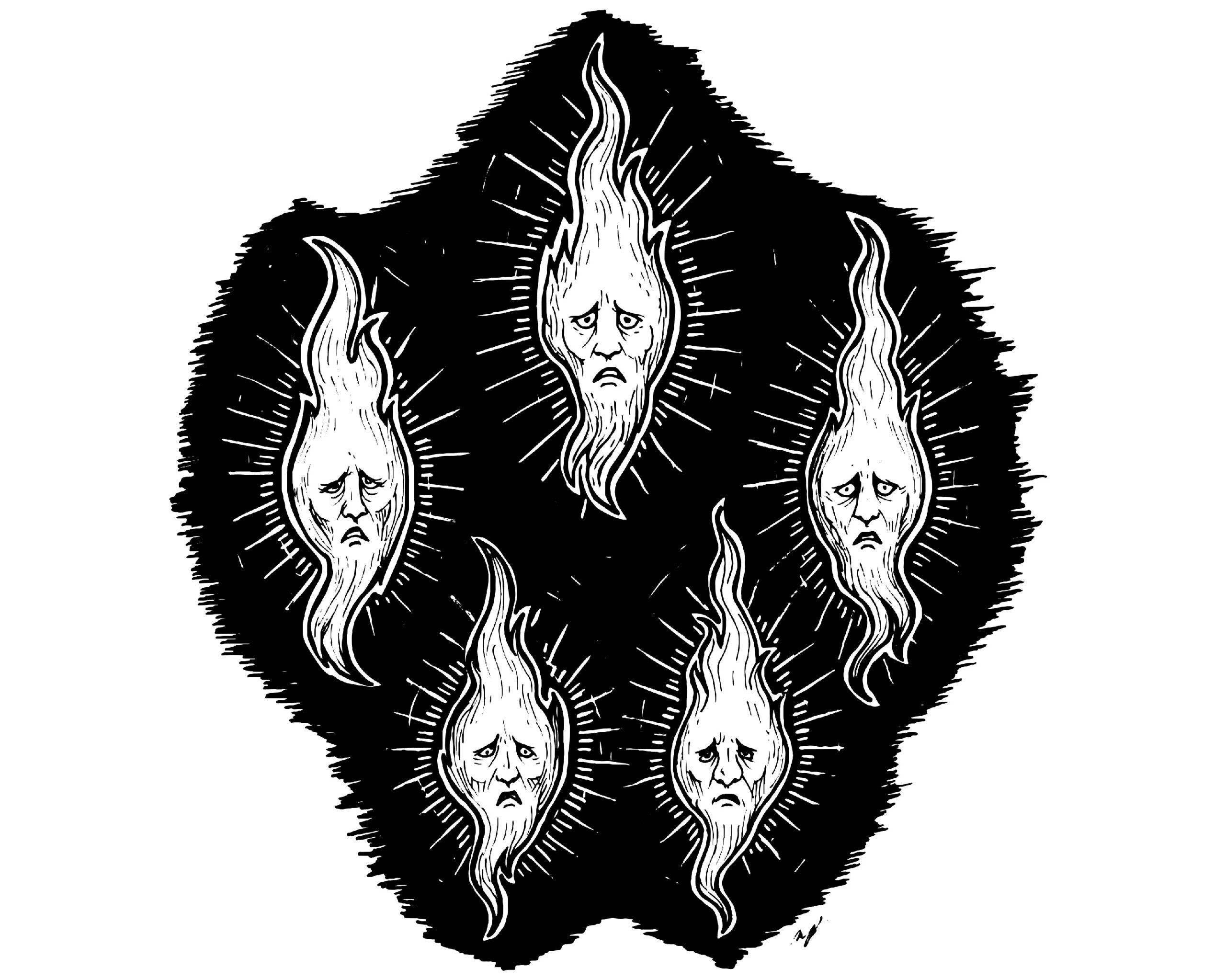
Illustration by Meg Pelliccio.
Instead of unearthing some old newspaper gem this week, I was recommended to look into corpse candles, specifically, the five corpse candles of Llangathen that supposedly predicted the deaths of five women, and that meant digging into a good old antiquarian book.
What Are Corpse Candles?
Corpse candles, also known as corpse lights, were small floating flames, seemingly similar in appearance to will-o’-the-wisps. However, rather than leading wandering travellers astray, they were thought to predict that a death would soon occur.
Beliefs varied about exactly how they predicted deaths. They might appear at the victim’s home, at the place where the death would occur, above where the grave would be dug, or along the road the funeral procession would later take.
Charlotte Latham wrote in the first volume of The Folk-Lore Record that in a West Sussex village where she once lived, the belief was very common, as the lights were believed to be “The hateful messenger of heavy things, of death and dolour telling.”
She goes on to state, “Considerable alarm was once created in that same village by a pale light being observed to move over the bed of a sick person, and, after flicking for some time in different parts of the room, to vanish through the window. Of course so mysterious a manifestation was pronounced to be a warning, and the nurse avowed moreover that she had seen such light some scores of times, but out of doors, and she believed a death had always followed.”1
Possible natural explanations include “the result of ignited marsh gas”, as suggested in Folklore, Myths and Legends of Britain2, while Latham considered whether each light could simply have been a “male glow-worm”.3
A lot of corpse candle stories seem to come from Wales, where they were known as canhwyllau cyrff or canwyll corff. One particularly detailed early account was written by Welsh minister John Davis in a letter dated 1656, which Richard Baxter later published. Davis said the belief was common across Cardiganshire, Carmarthenshire, and Pembrokeshire, though similar stories also cropped up elsewhere in Britain.
The Five Corpse Candles of Llangathen
In 1691, Richard Baxter published The Certainty of the Worlds of Spirits, which contained a section titled ‘Mr. Davis’s Letter, concerning the Corps-Candles in Wales’.
Davis records an account from his sister-in-law, Jane Wyat, concerning an event that had occurred 34-35 years earlier. As his letter was dated 19 March 1656, this would place the incident around 1621-1622. While working in the household of Baronet Rudd at Llangathen, Carmarthenshire, she entered the maidservants’ bedroom and “saw no less then [sic] five of these lights together.”4
Some time later, the room was freshly plastered, and “a great grate of Coalfire” was lit to help it dry more quickly. Five maidservants then went to sleep in the room, but all were found dead the following morning. Davis described the women as “being Suffocated (I conceive) in their Sleep with the Steem [sic] of the New-tempered Lime and Coal.” Essentially, he believed their deaths had been caused by inhaling noxious fumes.
Corpse candles were not believed to cause deaths but were instead harbingers of deaths that would soon occur. The five corpse candles of Llangathen appear to be an unusually large recorded group. Most accounts I have found involve only one or two lights, while Davis himself refers more generally to “two or three, or more”. In the published sources I have examined so far, I have not found another account involving more than five corpse candles.
What Else Could Corpse Candles Predict?
Corpse candles weren’t always vague warnings that someone would die soon, but were sometimes believed to offer more detail in their appearance.
The colour of the flame gave some clues, too: “If a child’s death was foretold, the flame was blue; in the case of an adult, yellow.”5 Meanwhile, Davis wrote: “If it be a little Candle, pale or blewish, then, follows the Corps either of an Abortive, or some Infant, if a big one, then the Corps of some one come to Age, if there be seen two or three, or more, some big, some small together, then so many, and such Corpses together.”6
As an example, Davis tells the story of his sexton’s wife, who saw a bluish candle flame at the end of her table. Within a few days, a man visited to enquire after her husband, and she saw him take “something from under his Cloak, and claps it down directly upon the Tables end, where she had seen the Candle, and what was it, but a Dead-born child?”7
This was not the only occasion either. The same woman later witnessed another candle at the opposite end of the table. Only a few days afterwards, a weak, newly christened child was brought to the sexton’s house and died. When the sexton’s wife returned home, she found the child being shrouded and prepared for burial on the very same table end where she had seen the candle.
It wasn’t just the colour of the candle, but also the size. Davis details another incident where his mother-in-law “saw two little Lights just upon her Belly, which she assayed to strike off with her Hand, but could not; within a while they vanished of themselves. Not long after, she was Delivered of two Dead-born Children.”8
In another account, Davis describes how the size of the corpse candles indicated both an adult and an unborn child: “a Neighbours Wife of mine, being great with Child, and coming in at her own Door, met two Candles, a little, and a bigg one, and within a little after, falling in Labour, she and her Child both dyed.”9 Again, the number of candles matched the number of people who later died.
Corpse candles were also believed to trace a victim’s final movements. Davis gives a particular account as evidence for this, explaining that when he was 15 years old and living in Lanylar (Llanilar), some of his neighbours saw a corpse candle hovering up and down a river bank one evening. A few weeks later, a woman from Montgomeryshire came and wanted to cross the river to visit a friend who lived on the other side.
She intended to cross at the exact place where the corpse candle had been seen but was dissuaded by onlookers. Davis speculated that some of them may have known about the earlier sighting and feared what it foretold. However, while waiting for the floodwater to fall, the woman walked up and down the riverbank, mirroring the movements of the light even more closely. Davis explained, “she walked up and down along the River Bank, even where, and even as the foresaid Candle did, waiting for the falling of the Water, which at last she took; but too soon for her, for she was drown’d therein.”10
How Reliable Is the Llangathen Account?
Davis’s account was not first-hand. He was retelling something his sister-in-law had reported, and wrote it down some 34 or 35 years after it allegedly happened. None of the maidservants is named, and without an exact date, it is difficult to corroborate the deaths through surviving records.
That doesn’t mean it never happened, though. Davis offered an earthly explanation for the women’s deaths, even if the supposed appearance of the corpse candles remains impossible to corroborate.
Davis concludes his letter by defending the credibility of both his witnesses and himself: “So many of these Evidences, as I saw not my self, I received from Understanding and Credible Persons, and such as would not lye, no, not for a Benefice; and your self may receive the same from me, as from one that was never too Credulous, nothing Supperstitious, and as little Ceremonious.”11
A benefice was a paid church position, so this was Davis’s way of saying his witnesses wouldn’t lie even if there was something substantial in it for them.
We’ll never know for certain whether Jane Wyat truly saw five strange lights before five maidservants died, but that doesn’t make the tale any less fascinating. The women’s deaths have a plausible natural explanation, while the five lights supposedly seen beforehand remain impossible to explain or corroborate. It is that mixture of a very real tragedy and an apparently supernatural warning that makes the corpse candles of Llangathen particularly compelling.
Archive Sources
- Charlotte Latham, “Some West Sussex Superstitions Lingering in 1868,” The Folk-Lore Record 1, no. 1 (1878): p.53-54. ↩︎
- Russell Ash, ed., Folklore, Myths and Legends of Britain, 2nd ed. (London: Reader’s Digest, 1977), p.89. ↩︎
- Latham, “West Sussex Superstitions,” p. 54. ↩︎
- Richard Baxter, The Certainty of the Worlds of Spirits (London: T. Parkhurst and J. Salusbury, 1691), p.141, Wikimedia Commons, accessed 23 July 2026. ↩︎
- Ash, Folklore, Myths and Legends of Britain, 89. ↩︎
- Baxter, Certainty of the Worlds of Spirits, p.138. ↩︎
- Baxter, Certainty of the Worlds of Spirits, p.139 ↩︎
- Baxter, Certainty of the Worlds of Spirits, p.140. ↩︎
- Baxter, Certainty of the Worlds of Spirits, p.140. ↩︎
- Baxter, Certainty of the Worlds of Spirits, p.138-139. ↩︎
- Baxter, Certainty of the Worlds of Spirits, p.145. ↩︎
Subscribe to The Folklore Archive!
Each fortnight for The Folklore Archive, I’ll uncover lost stories, superstitions, and traditions that have faded from memory by digging into old historical newspapers and folklore collections.
From mischievous pixies to curious folk remedies, if you want to read about the weird and wonderful history of British folklore, I’ll deliver it straight to your inbox.
I’ll also be sharing my original pen-and-ink illustrations and updates on my writing projects, particularly for my book on Devon Folklore.
I’d love to have you along for the journey, so please subscribe below!
Occasionally, the first edition wanders into the junk folder. Newsletters are sent from author@megpelliccio.co.uk, so please add the address to your contacts and check your junk folder when the next issue arrives.