
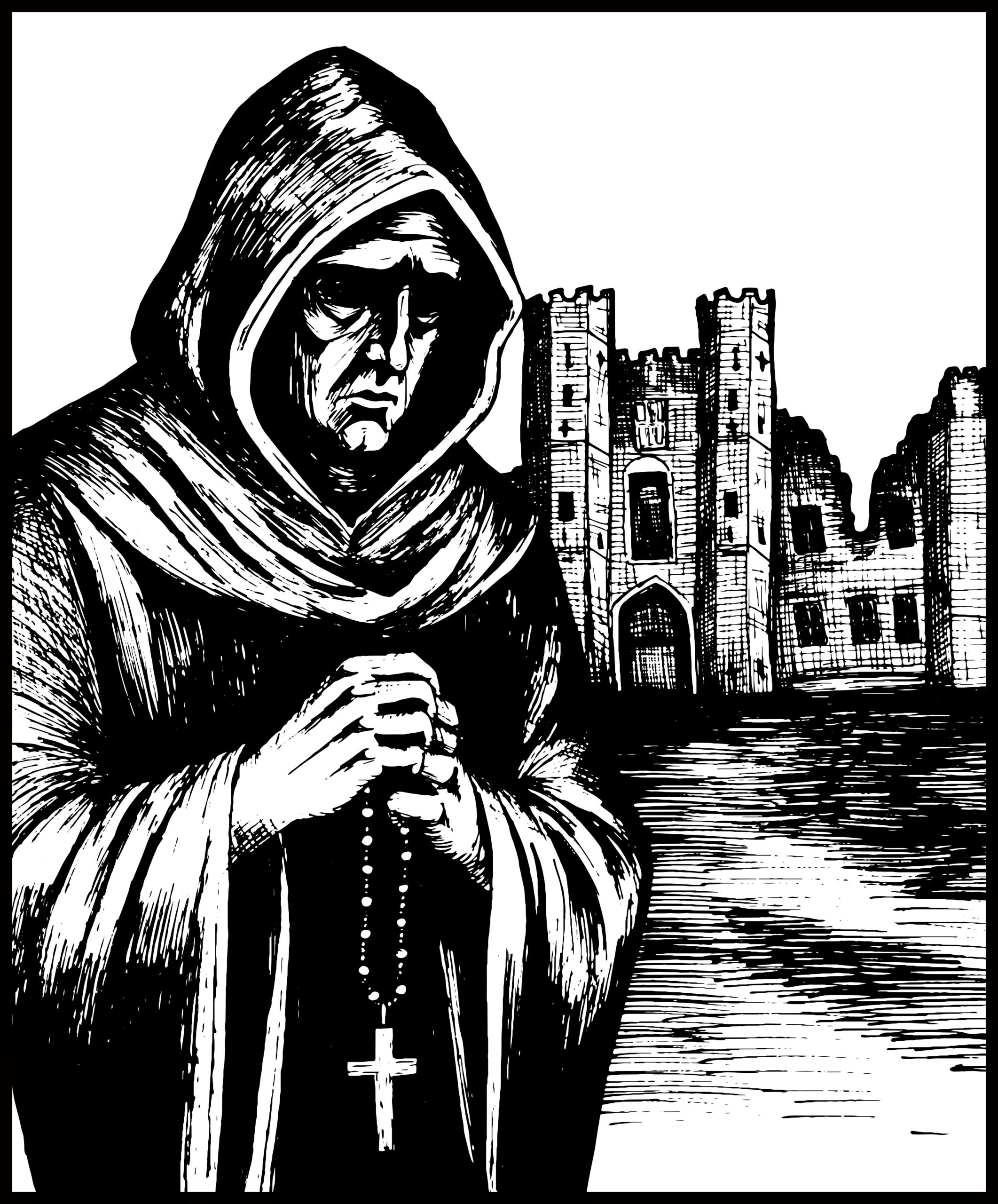
Illustration by Meg Pelliccio.
We’ve all heard stories of curses, whether local, legendary, or little-known tales passed down orally from generation to generation. The tales often change over time, evolving or becoming more elaborate, and it can be difficult to work out what the original details of the curse were, or where it truly originated.
This week, I’ve been digging into the curse of Cowdray Castle after reading a newspaper article from 1909.
THE MONK’S CURSE.
In her interesting article “Noble Houses with Strange Histories,” which appears in the Christmas number of “Cassell’s Magazine,” Mabel Greenwood tells of the strange curse which hangs over Cowdray Castle. Sir Anthony Brown began to build the castle directly the poor monks were swept out, and at the first banquet he gave on completing the castle, a skeleton appeared in the shape of one of the dispossessed monks, who, holding up his hand in sight of all, uttered the terrible curse that by fire and water Sir Anthony’s descendants and house should perish out of the land.
The curse seems to have been quiescent till the year of the great French Revolution, when the sudden news of the death of the eighth Lord Montacute (Sir Anthony’s descendant, and the last of the direct line) was received, through his foolhardy attempt to swim the dangerous rapids of Laufenburg, on the Rhine. Within a few days of this peer’s demise the news came that the princely seat in Sussex was burned to the ground, and, excepting the bare stone walls standing to-day as grandly as ever, nothing of Cowdray Castle was saved from total destruction! Thus, the latter owners of the property preferred to build on another site in the vast park, knowing the strange history that hung over the place.1
What is the curse of Cowdray Castle?
The curse of Cowdray Castle supposedly dates back to the Dissolution of the Monasteries, when Sir Anthony Browne came into possession of former religious lands. According to the legend, a monk (or, depending on which version you read, a nun or prioress) cursed Browne and his descendants for profiting from the loss of church property, declaring that his family and home would eventually be destroyed by fire and water.
And that’s exactly what appears to have happened. In 1793, fire devastated Cowdray House. Then later, its owner, George Samuel Browne, 8th Viscount Montagu, drowned while attempting to navigate the rapids of the Rhine at Laufenburg.
Things get even stranger still in 1815 when two young members of the family drowned in a boating accident near Bognor. Their deaths later became wrapped up in the Cowdray curse too, seemingly offering yet more proof that the prophecy had come true.
The problem is that once you start looking into the curse itself, things get a lot less straightforward. Different accounts can’t agree on who actually made the prophecy, where it happened, or even some of the circumstances surrounding it. More importantly, while the fire and drownings are very real, that doesn’t necessarily mean the prophecy came first.
Historical sources variously spell the title Montagu, Montague and Montacute; I use Montagu throughout except in direct quotations.
What really happened at Cowdray in 1793?
Before getting into when the curse first appeared, it’s worth putting the legend to one side for a moment, because the fire and drowning at the heart of it really did happen.
On the night of 24 September 1793, Cowdray House caught fire while work was being carried out ahead of Lord Montagu’s return from the Continent. Antiquary Richard Gough visited the ruins less than a month later, on 22 October, and recorded what he was able to find out about what happened.2
According to Gough, Cowdray’s housekeeper had gone to bed that night with nothing apparently wrong. Within about an hour, she was woken by the watchman shouting that there was a fire in the North Gallery.
This was particularly bad timing as a large number of family portraits and historical paintings had temporarily been moved into the gallery while other parts of Cowdray were being repaired. The fire spread through the house, including the Great Hall, chapel, and dining parlour, and although people came from nearby Midhurst to help, much of the house and its contents were lost.
Julia Roundell gives a slightly different account in 1884, using some earlier sources. She says flames were seen coming from the carpenter’s shop at the top of the north-west tower, and that attempts to fight the fire were delayed because the key to the building containing the fire hose and buckets could not initially be found.3 By the following morning, Cowdray was a ruin.
As awful as the fire was, it’s what happened to Cowdray’s owner shortly afterwards that really helped create the perfect ingredients for the later curse story.
George Samuel Browne, 8th Viscount Montagu, was travelling on the Continent with his friend Charles Sedley Burdett when the pair attempted to take a small boat through the dangerous rapids of the Rhine at Laufenburg. Unfortunately, their boat was lost in the rapids and both men drowned.
Later retellings often make the fire and drowning sound as though they happened almost simultaneously, but that appears to be another example of the story becoming tidier over time. Cowdray burned on 24 September, while Montagu’s death appears to have happened in October.
There were already a few extra tragic details attached to Montagu’s death at the time. The Gentleman’s Magazine reported in 1793 that he was expected to marry Miss Coutts on his return to England.4 A letter published in a later volume of The Gentleman’s Magazine claims that Cowdray’s renovations had been finished the day before the fire, and that a letter had been sent to Montagu telling him the work was complete. A second letter was then sent telling him that Cowdray had burned, but it was apparently misaddressed to Lausanne instead of Lucerne, delaying it by two days.5
Whether every detail of that story happened exactly as later writers say is hard to say, but the main coincidence is real enough: Cowdray was destroyed by fire, and only a short time later its owner died in water.
What I haven’t found in the earliest accounts is any mention of a monk, a prophecy, or a curse of fire and water. Gough’s account goes into plenty of detail about the fire, but says nothing about any old warning supposedly coming true.
And that leaves the obvious question: if the curse really predicted what happened in 1793, when does anyone actually start talking about it?
When was the Cowdray curse first recorded?
1909
Let’s get back on the case of following the trail of the curse. The 1909 Bromyard News newspaper clipping is what I stumbled across first. It describes a skeletal monk who appears at a banquet and curses Browne’s descendants to perish by fire and water. However, I wanted to trace the history of the curse and find out exactly when it was first recorded.
1904
Tracing the story back only five years earlier, the version being told was already different to the more recent one, notably lacking the dramatic entrance of a skeletal apparition at a banquet. In E. V. Lucas’s Highways and Byways in Sussex, first published in 1904, the curse itself remains the same, but the story of how it was delivered is different.
Lucas also appears to tidy up some of the surrounding details, claiming that Montagu drowned just a week after the fire and that the Poyntz sons later drowned while bathing at Bognor, rather than in the boating accident described in earlier accounts.
“Legend says that as the last monk departed, he warned his despoiler that by fire and water his line should perish. By fire and water it perished indeed. A week after Cowdray House was burned, in 1793, the last Viscount Montagu was drowned in the Rhine. His only sister (the wife of Mr. Stephen Poyntz) who inherited, was the mother of two sons both of whom were drowned while bathing at Bognor. When Mr. Poyntz sold the estate to the Earl of Egmont, we may suppose the curse to have been withdrawn.”6
1884 | 1878-79
In 1884, Julia Roundell published Cowdray: The History of a Great English House, in which she delves into two possible origins of the curse. According to Roundell, the more commonly accepted version of the curse is that “when Sir Anthony was holding his first great feast in the Abbotts Hall at Battle, a monk made his way through the crowd of guests, and striding up to the dais on which Sir Anthony sat, cursed him to his face,” ending with the warning: “By fire and water thy line shall come to an end, and it shall perish out of the land.”7
Roundell also pointed to a very different version published only a few years earlier. “The Story of a Curse”, originally serialised in the Catholic magazine The Lamp in 1878–79 and later partially reprinted by Roundell, attributed the curse to the Sub-Prioress of Easebourne. According to this version, when the King’s Commissioners called on the Prioress to resign the keys of the house and the Sub-Prioress was required to countersign the surrender, it was then that the brave woman warned them of the fire-and-water curse.
“‘Heed ye well, my masters,’ she said, ‘what ye do. The pious founders of this house left a heavy and terrible malison on all who should molest and harry us, poor and unworthy servants though we be of Christ and St. Benedict, and on all who in after time should aid or profit by a deed of sacrilege. As the traditions of our house and of the faithful people of Easebourne attest, a curse of fire and water on the male children and heirs of the spoilers is invoked by those who gave lands and protection to the spouses of Christ dwelling in Easebourne Priory, for the rest of their souls, and in perpetual remembrance of their charity. That curse ye are about to incur. He who takes these lands it shall come upon him, and his name shall die out. It shall follow as the heritage of the race that comes after him, and it shall continue even until the end.’”8
By this point, the story was already far from fixed. Even the identity of the person supposedly responsible for the curse depended on which version you read.
1851 – Did the curse strike again?
Digging back further, the curse was discussed in Notes and Queries in 1851 by a contributor signing as E. Rds., who shared what appears to have been the most commonly told version: a monk appearing during a feast and announcing the curse to those in attendance.
“They relate, that while the great Sir Antony (temp. Hen. VIII.) was holding a revel, a monk presented himself before the guests and pronounced the curse of fire and water against the male descendants of the family, till none should be left, because the knight had received and was retaining the church-lands of Battle Abbey, and those which belonged to the priory of Eastbourne [sic]. Within the last hundred years, destiny, though slow of foot, has overtaken the fated race. In one day the hall perished by fire, and the lord by water, as mentioned by E. H. Y.”9
After Lord Montagu’s death, Cowdray passed to his sister, Mary Browne, who married William Stephen Poyntz. Their two sons later drowned in the boating accident at Bognor in 1815. It seems the curse had not relinquished its grip on the descendants and relatives of the Browne family.
1831
The earliest printed record I could find that references the curse is from 1831, in John Wilson Croker’s edition of James Boswell’s The Life of Samuel Johnson. In a note, Croker recalls visiting Cowdray “some twenty years ago” and being told that the curse of both fire and water had fallen on the estate.10 If his memory was accurate, that means the idea that Cowdray was cursed by fire and water was already being repeated locally around 1811.
That pushes the story back almost a century from the 1909 newspaper clipping that started my search. However, there was still one obvious problem: Cowdray had burned and Lord Montagu had drowned in 1793. So did the curse really exist before the events took place, or was it conjured up only after Cowdray burned and Lord Montagu drowned?
What came first: the curse or the catastrophe?
In Sacrilege, Tractarian Fiction and the Very Long Reformation, Alison Shell traces the Cowdray story and how it developed, and even references some more obscure sources I hadn’t come across. Shell argues that “rumours of a curse arose in the late eighteenth and early nineteenth centuries after a series of tragic events,” specifically the 1793 fire and drowning and the later 1815 boating tragedy.11
She also places the Cowdray curse within a much wider tradition of what she calls sacrilege narratives. The basic idea was that people who profited from land or property taken from the Church during the Reformation could eventually face some kind of punishment for it, even if that punishment did not arrive until generations later.
Cowdray was almost perfect material for that kind of story. The Browne family had benefited from former religious property, including Battle Abbey, and then centuries later their family home burned down while its owner died in water. Another two members of the family drowned in 1815. Once those events were viewed through the idea of punishment for sacrilege, it isn’t difficult to see how a curse involving fire and water could take hold.
Importantly though, that still doesn’t tell us that the curse existed before the disasters. If anything, Shell’s assessment points in the opposite direction: the rumours appear to have grown out of the tragedies rather than the tragedies fulfilling a documented Tudor prophecy.
That fits with what I found while following the story backwards. The earliest printed reference I could find was John Wilson Croker’s account from 1831, although he claimed to have heard the superstition himself when visiting Cowdray around twenty years earlier. That would put the fire-and-water tradition in circulation by roughly 1811.
This is significant because it places the fire-and-water tradition before the Poyntz drownings of 1815, meaning those later deaths really did happen after the superstition was apparently already being repeated. But it still leaves an awkward gap when it comes to the two events at the centre of the story.
Cowdray burned in 1793. Lord Montagu drowned that same year. So far, I haven’t found anyone mentioning the curse before either of them happened.
That doesn’t prove that nobody was telling some version of the story orally before 1793, but there is currently no evidence I can find for the neat Tudor prophecy described in later accounts. Instead, the surviving sources suggest something much messier, and, to me, much more fascinating: real tragedies happened first, a curse began to form around them, and later events and retellings helped turn it into the story we know now.
So was Cowdray Castle really cursed?
The 1793 fire and drowning happened before the earliest evidence I’ve found for the curse. The 1815 drownings are different. If Croker’s recollection is accurate, the fire-and-water superstition was already circulating by then.
It’s possible that the story of the curse only began to circulate after the fire and drowning of Lord Montagu, as a way to explain the family’s misfortune and perhaps serve as a warning about the punishment that might befall those who profited from former church property. Or perhaps the curse really was being told before these events, but remained an oral tradition for so long that no earlier record of it survives.
We simply don’t know.
What we can say is that the 1815 drownings would have made the story seem even more convincing. If people were already saying that Cowdray was doomed by fire and water, two more deaths by water only a few years later must have felt like further proof that the curse was very real.
Personally, I think the surviving evidence points more towards a piece of folklore growing around a very strange series of tragedies than a centuries-old prophecy coming true. But without an earlier source, there’s no way to completely rule out the possibility that some version of the curse was already being passed around orally before 1793.
Archive sources
- Bromyard News, 2 December 1909, p. 6, “The Monk’s Curse,” via Findmypast. ↩︎
- Richard Gough, “Six Views of Cowdray House,” Vetusta Monumenta, vol. 3, plates XXXIII–XXXVII, letter dated 7 November 1793, Society of Antiquaries of London. ↩︎
- Julia Anne Elizabeth Roundell, Cowdray: The History of a Great English House (London: Bickers & Son, 1884), p. 126–127. ↩︎
- The Gentleman’s Magazine and Historical Review, vol. 63, part II (1793), p. 1054. ↩︎
- Mr Quinton, “Cowdray House,” The Gentleman’s Magazine and Historical Review, vol. 68, part I (May 1798), p. 371. ↩︎
- E. V. Lucas, Highways and Byways in Sussex (London: Macmillan and Co., 1904), p. 8. ↩︎
- Julia Anne Elizabeth Roundell, Cowdray: The History of a Great English House (London: Bickers & Son, 1884), p. 141. ↩︎
- Julia Anne Elizabeth Roundell, Cowdray: The History of a Great English House (London: Bickers & Son, 1884), p. 163. ↩︎
- E. Rds., “The Brownes of Cowdray, Sussex,” Notes and Queries, no. 71, 8 March 1851, p. 194. ↩︎
- James Boswell, The Life of Samuel Johnson, LL.D., Including a Journal of a Tour to the Hebrides, ed. John Wilson Croker, vol. IV (London: John Murray, 1831), p. 112. ↩︎
- Alison Shell, “Sacrilege, Tractarian Fiction and the Very Long Reformation,” Reformation 24, no. 2 (2019): 195–209, p. 199. ↩︎
Subscribe to The Folklore Archive!
Each month for The Folklore Archive, I’ll uncover lost stories, superstitions, and traditions that have faded from memory by digging into old historical newspapers and folklore collections.
From mischievous pixies to curious folk remedies, if you want to read about the weird and wonderful history of British folklore, I’ll deliver it straight to your inbox.
I’ll also be sharing my original pen-and-ink illustrations and updates on my writing projects, particularly for my book on Devon Folklore.
I’d love to have you along for the journey, so please subscribe below!
Occasionally, the first edition wanders into the junk folder. Newsletters are sent from author@megpelliccio.co.uk, so please add the address to your contacts and check your junk folder when the next issue arrives.