
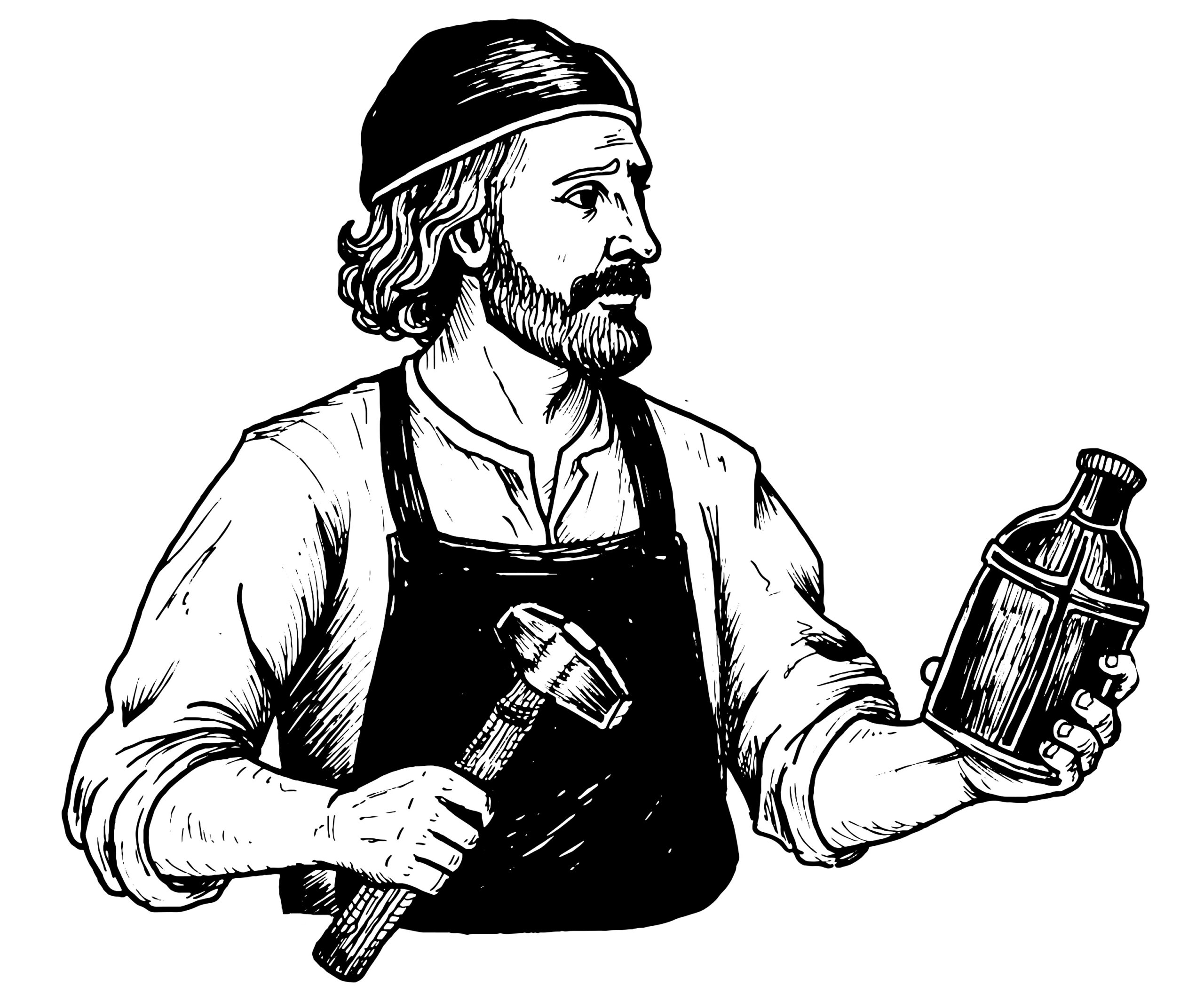
Illustration by Meg Pelliccio.
While sifting through old Devonshire newspapers, I stumbled across an interesting article in The Totnes Times and Devon News from November 10, 1900, which reports on the death of a very curious character tied to the history of witch bottles and one particularly famous wizard.
END OF A WEIRD CHARACTER
On Saturday morning the lifeless body of Stephen Choppen, aged sixty-eight, was found hanging to a beam in an outbuilding adjoining his picturesque little cottage at Hadleigh (Essex). Deceased was a retired blacksmith, and lately suffered from gout. Many years ago he forged the celebrated iron witch bottles for a notorious local wizard named Murrell. In these bottles were placed blood, water, finger-nails, hair, and pins. When screwed up air-tight these bottles were set on fire by way of a “charm” against witches, and frequently burst, thus signalising the destruction of the latter’s diabolical influences. Choppen told an anecdote of the first bottle, which, he said, refused to be welded until Murrell arrived and blew the fire, when all went well. 1
What Are Witch Bottles?
Witch bottles helped to ward off evil or undo the witchcraft of an evil practitioner of magic. Witch bottles appear to have been used from at least the sixteenth century, although one of the earliest written descriptions dates from 1681, in Joseph Glanvill’s Saducismus Triumphatus, or Evidence Concerning Witches and Apparitions. 2
The earliest versions of witch bottles used Bartmann or Bellarmine stoneware jugs, characterised by their distinctive moulded decorations depicting bearded faces, but later versions used glass bottles and vials, as well as other containers.
There are many variations of how witch bottles were used and believed to work. Many had the hair, urine, and nail clippings of the person believed to have been bewitched placed inside, while other bottles have been found to include wine, pins, needles, and herbs.
Witch bottle instructions largely fell into one of two categories. The first was to dispose of the bottle, often by throwing it into a fire until it exploded, at which point the spell would be broken. The second was to bury the bottle on the property, sometimes within the wall of the house itself, beneath the floor, or at the farthest property corner. These bottles continued to act as protective charms for as long as they remained hidden and intact.
Witch bottles are still found in old buildings to this day, hidden in the most obscure of places. One particularly humorous account involves the Antiques Roadshow TV show. A visitor brought in a bottle in 2016, and glass expert Andy McConnell tasted it, believing it to be a 150-year-old bottle of port. Unfortunately for him, tests conducted years later revealed that the bottle contained brass pins, a single human hair, an ostracod, and a liquid mixture of alcohol and urine. 3 At least McConnell didn’t claim it tasted good at the time.
Who Was The Wizard Named Murrell?
James Murrell was born the seventh son of a seventh son in 1785 in Rochford, Essex, and later moved to Hadleigh in 1812. There, he gained the reputation as a white witch/magician known as “Cunning Murrell”, and described himself as “The Devil’s Master”, claiming to be able to exorcise spirits and counter evil witchcraft with his spells.
Murrell employed a variety of magical practices, including various charms and devices, such as “a magic mirror for discovering lost or stolen property, a telescope for looking through walls and a copper charm which could distinguish between honest and dishonest clients”.4 He was also reportedly able to curse thieves until they returned their stolen goods and knew anything and everything, regardless of whether it was about the past, present, or future, and could divine prophecies using the stars. 5
However, he was best known for his use of iron witch bottles, into which he put samples of blood, urine, nails, and hair taken from clients he believed had been bewitched. At midnight, this peculiar concoction would be heated until boiling point, in complete silence. This was expected to cause a burning sensation in the body of the witch who had cast the evil spell and force her to undo her foul work.
One particular tale about Murrell and his witch bottles involved a poor girl who had been cursed so badly that she barked like a dog. Murrell heated the witch bottle by night, and it exploded. The next day, the charred body of a woman was found in a lane, believed to have been the witch responsible, no doubt.
Murrell died of natural causes on December 15, 1860, and his life ended as peculiarly as he had lived, with him correctly predicting his own death to the exact minute the day before he passed.
Though the newspaper article above refers to Murrell as “a notorious local wizard”, the people of Essex considered him a “white and lawful wizard, who warred against the powers of darkness with all his might”. 6
Who Was Stephen Choppen?
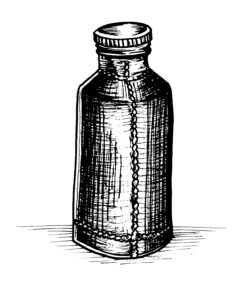
Stephen Choppen was a blacksmith who crafted Murrell’s iron witch bottles. This design was a rarity, as most witch bottles were made of earthenware or glass, and no surviving examples of iron witch bottles exist.
In an interview with Arthur Morrison, published in The Strand Magazine in 1900, only a few months before Choppen’s death, the blacksmith explained that there were no witch bottles left to show, as “the last had been exploded long ago”.7
In Morrison’s article, Choppen tells the tale of Edward Murrell, referred to as “old Buck Murrell”, who was the son of the late wizard. After his father’s death, old Buck Murrell had attempted to follow in his father’s footsteps and had used the last of the witch bottles, filling it the same as his father had done countless times before, and warned the client not to say a word while he threw it on the fire.
“Now this bottle must ha’ been one o’ my best, an’ it holds the bilin’ stuff an’ steam in for a long time, they two a-sittin’ either side the grate a-waitin’. Presently the other chap gets impatient, and says he, ‘I don’t believe this here bottle’s a good ’un.’ ‘Danged!’ shouts Buck, ‘you’ve spiled the charm!’ An’ at that ‘BANG!’ goes the bottle, an’ bundles the pair on ’em over neck an’ crop on the floor, down comes all the pots an’ kettles with a run, an’ when they gets enough sense in ’em to look round they finds the whole chimney-breast blowed up, mantelpiece, grate an’ all, an’ pretty nigh one side o’ the house fetched out. That was the end o’ the last bottle, an’ old Buck Murrell, he aren’t been in the witchcraft line since.” 8
There may still be hundreds of witch bottles waiting to be found throughout England, buried beneath old floorboards or hidden inside walls, their peculiar contents still marinating within and supposedly protecting owners who have long since died.
Stephen Choppen’s name survives almost entirely because of the strange iron vessels he forged for the wizard James Murrell, and such a curious tale is not the worst way to be remembered.
Archive Sources
- “End of a Weird Character”, The Totnes Times and Devon News, 10 November 1900, p.7. ↩︎
- Joseph Glanvill, Saducismus Triumphatus: Or, Full and Plain Evidence Concerning Witches and Apparitions, London: Printed for A. L. and sold by Roger Tuckyr, 1700, Internet Archive, accessed 5 July 2026. ↩︎
- Daily Mirror, “Antiques Roadshow Expert Tastes 150-Year-Old Port Before Discovering It Was Actually Urine”, 29 December 2019, accessed 5 July 2026 ↩︎
- Russell Ash, ed., Folklore, Myths and Legends of Britain, 2nd ed. (London: Reader’s Digest, 1977), p.236-237 ↩︎
- Arthur Morrison, “Cunning Murrell”, The Strand Magazine 19, no. 112 (April 1900): p. 433. Accessed via Victorian Voices. ↩︎
- Morrison, “Cunning Murrell,” p. 434 ↩︎
- Morrison, “Cunning Murrell,” p. 435 ↩︎
- Morrison, “Cunning Murrell,” p. 436 ↩︎
Subscribe to The Folklore Archive!
Each fortnight for The Folklore Archive, I’ll uncover lost stories, superstitions, and traditions that have faded from memory by digging into old historical newspapers and folklore collections.
From mischievous pixies to curious folk remedies, if you want to read about the weird and wonderful history of British folklore, I’ll deliver it straight to your inbox.
I’ll also be sharing my original pen-and-ink illustrations and updates on my writing projects, particularly for my book on Devon Folklore.
I’d love to have you along for the journey, so please subscribe below!
Occasionally, the first edition wanders into the junk folder. Newsletters are sent from author@megpelliccio.co.uk, so please add the address to your contacts and check your junk folder when the next issue arrives.