
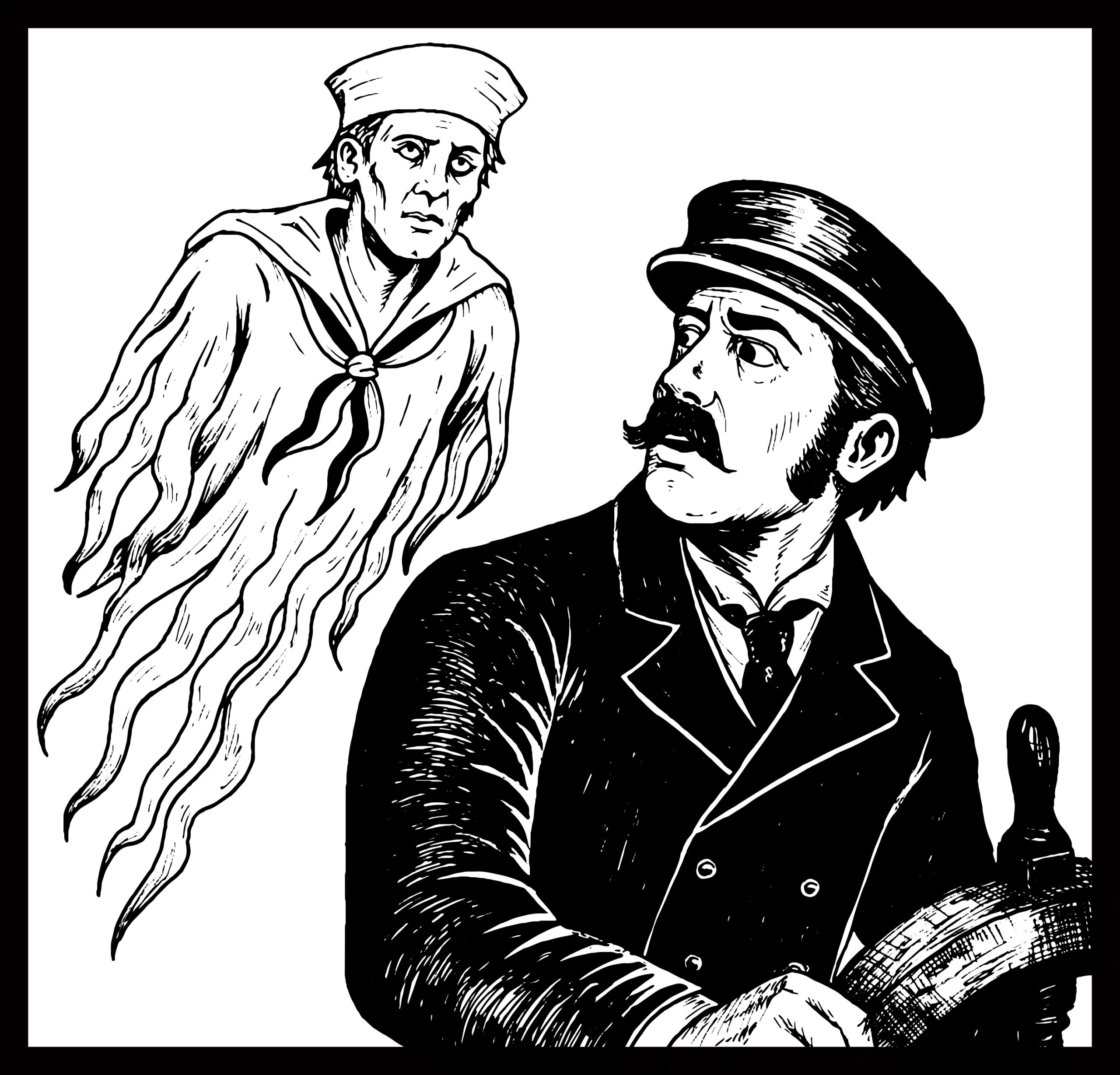
Illustration by Meg Pelliccio.
This week I’ve been on a ghost hunt, tracking down the original story of a phantom sailor who was mentioned in The North-Eastern Daily Gazette in 1887. This account features a ghost with no name, but as I went further back through the records, I discovered there was more to this haunting tale than this first article revealed.
The Marine Ghost With No Name
Writing under the name “A Seafarer”, the anonymous author recounts several marine ghost stories in The North-Eastern Daily Gazette, including Sir Walter Scott’s tale of a captain who murdered a sailor aboard his ship and suffered the consequences.
“Some very extraordinary ghostly figures have been encountered upon the ocean. Sir Walter Scott somewhere tells of a captain who killed a man. Whilst gasping his last the man declared he would haunt the skipper, to remedy which he (the skipper), a veritable Captain Murder in his way, popped the body in a huge kettle and boiled it. That this did not influence the decision of the ghost is proved by the crew believing that the murdered man took his trick at the wheel as usual, and that he went aloft when occasion required with the others of the watch to which he had belonged to in life. I cannot imagine a more uncomfortable position than that of standing at a ship’s wheel and discovering the lee spokes to be grasped by what Dr. Johnson calls a ‘shadowy being.’”1
The tale wasn’t sourced beyond naming Sir Walter Scott, but the grisly murder and disposal of the body followed by a haunting aboard the ship was a tantalising case I couldn’t help but be captivated by. It was time to learn more.
Who Was the Murdered Sailor in Walter Scott’s Story?
Digging through the archives, I found another iteration of this tale from thirteen years prior. An article in The People’s Friend in 1874 named the sailor who was killed as Bill Jones and gave more chilling details to the tale.
In this version, Scott himself was said to have found himself in the company of a middle-aged sailor while travelling to London. This mariner told Scott about a vessel travelling from Liverpool to the West Indies that he had been aboard during his youth. He described the captain of the ship as a “man of variable temper, sometimes kind and courteous to his men, but subject to fits of humour, dislike, and passion, during which he was very violent, tyrannical, and cruel”.2
The captain took a particular dislike to an elderly sailor by the name of Bill Jones and often spoke to him with “threats and abuse”, and Jones would apparently retort. On one occasion, when Jones was slow to get out on the yard to hand a sail, the captain began his usual tirade towards him, and Jones reportedly “gave a saucy answer, almost amounting to mutiny”.3
Enraged, the captain went down to his cabin to retrieve his blunderbuss, and returned and took aim at Jones, mortally wounding the sailor. “The man was handed down from the yard and stretched on the deck, evidently dying. He fixed his eyes on the captain and said—‘Sir, you have done for me; but I will never leave you.’”4
Jones subsequently died from his wounds, and the captain swore the entire crew to silence. The sailor recounting the tale to Scott explained that he was confined below deck. When he regained his freedom a week later, he found that the whole crew believed “that the ghost of the dead man appeared among them when they had a spell of duty—especially if a sail was to be handed, on which occasion the spectre was sure to be out upon the yard before any of the crew”.5
The sailor told Scott he had seen the apparition himself more than once, and he believed that the captain had also seen it, though no one on the crew dared mention it to him because of his temper.
When the captain invited him for a drink, he reportedly told the sailor: “‘I need not tell you,’ he said, ‘what sort of a hand we have got on board with us. He told me he would never leave me, and he has kept his word. He is always by my side, and never out of my sight. At this very moment I see him. I am determined to bear it no longer, and I have resolved to leave you.’”6
The sailor warned the captain against leaving the vessel while there was no land in sight, and instead recommended that he should head for the west of France. However, the captain did not heed his warning, and the story ends with a chilling finale.
“At this moment I was called upon deck, and, the instant I got up the companion-ladder I heard a splash in the water, and, looking over the ship’s side, saw that the captain had thrown himself into the sea from the quarter-gallery, and was running astern at the rate of six knots an hour. When just about to sink, he seemed to make a last exertion, sprang half out of the water, and, clasping his hands, cried to me, ‘Bill Jones is with me now!’ and then sank to be seen no more.”7
Other than naming Scott again, the article still gave no source for the story, but this version provided far more detail, including those haunting final words from the captain. However, it omitted the grisly detail of what had happened to Jones’s body.

Did Walter Scott Really Meet the Sailor?
An earlier account in the Liverpool Saturday’s Advertiser in 1830 largely tells the same tale as the 1874 version, but reveals that the later retelling had altered the chain of testimony: it was not Scott who met the sailor, but his friend William Clerk. The article traces the account to Scott’s Letters on Demonology and Witchcraft.
It dates Clerk’s conversation with the mariner to around 1800 and specifies that the ship was a slave-trading vessel from Liverpool. Additionally, it recounts the original tale of Jones’s body being thrown into the kettle, but with added context:
“The captain, in return, swore at him for a fat lubber, and said he would have him thrown into the slave-kettle, where they made food for the negroes, and see how much fat he had got. The man died; his body was actually thrown into the slave-kettle, and the narrator observed, with a naïveté which confirmed the extent of his own belief in the truth of what he told, ‘There was not much fat about him after all.’”8
The account also explains that the sailor was confined below deck because he would not promise to remain silent about what had happened aboard the ship. He was released only after he “spoke his commander fair”.9
This shows that later retellings stripped away the slave-trading context and altered the chain of testimony.
What Walter Scott Actually Wrote and Believed
Scott’s fullest surviving prose account in Letters on Demonology and Witchcraft was published on 14 September 1830, just over a week before the article appeared in the Liverpool Saturday’s Advertiser, and maintains the same narrative.
Scott revealed that his account was not the story’s first appearance in print. With Clerk’s permission, he had previously passed the tale to “Mat Lewis, who published it with a ghost-ballad which he adjusted on the same theme”10. The writer was Gothic author Matthew “Monk” Lewis, whose “Bill Jones; A Tale of Wonder” appeared in the fourth volume of Romantic Tales in 1808, more than twenty years before Scott published his own prose account.11
In Letter X, however, Scott adds some ambiguity to the ghost sailor’s name, referring to him as “Bill Jones, or some such name”. He reinforces that Clerk, not Scott, was the person who heard the sailor’s account. Scott also acknowledged that the story could not be verified: “want of time and other circumstances prevented Mr Clerk from learning the names and dates, that might, to a certain degree, have verified the events”.12
Even granting that the murder had occurred and the story had been honestly told, Scott suggested that the crew’s fear and the captain’s remorse could explain both the apparition and the eventual suicide.
“Granting the murder to have taken place, and the tale to have been truly told, there was nothing more likely to arise among the ship’s company than the belief in the apparition; as the captain was a man of a passionate and irritable disposition, it was nowise improbable that he, the victim of remorse, should participate in the horrible visions of those less concerned, especially as he was compelled to avoid communicating his sentiments with any one else; and the catastrophe would in such a case be but the natural consequence of that superstitious remorse, which has conducted so many criminals to suicide or the gallows.”13
We’ll never be able to know for certain what happened to Bill Jones, if that was indeed his name, and whether he kept his promise and haunted the captain until his own fateful demise. What we do know is that it’s one heck of an interesting story to read.
Archive Sources
- “A Seafarer,” “Marine Ghosts,” North-Eastern Daily Gazette, 31 August 1887, p. 4, British Newspaper Archive, accessed 1 August 2026. ↩︎
- “The Sailor’s Ghost,” The People’s Friend, 10 June 1874, p. 216, Find My Past, accessed 1 August 2026. ↩︎
- “The Sailor’s Ghost,” p. 216. ↩︎
- “The Sailor’s Ghost,” p. 216. ↩︎
- “The Sailor’s Ghost,” p. 216. ↩︎
- “The Sailor’s Ghost,” p. 216. ↩︎
- “The Sailor’s Ghost,” p. 216. ↩︎
- “A Scrap of Ghostology,” Liverpool Saturday’s Advertiser, 25 September 1830, p. 6, British Newspaper Archive, accessed 1 August 2026. ↩︎
- “A Scrap of Ghostology,” Liverpool Saturday’s Advertiser, p. 6. ↩︎
- Scott, Letters on Demonology and Witchcraft, p. 366-67. ↩︎
- Matthew Gregory Lewis, “Bill Jones; A Tale of Wonder,” in Romantic Tales, vol. 4 (London: D. N. Shury for Longman, Hurst, Rees, and Orme, 1808). ↩︎
- Scott, Letters on Demonology and Witchcraft, p. 366. ↩︎
- Scott, Letters on Demonology and Witchcraft, pp. 366-367. ↩︎
Subscribe to The Folklore Archive!
Each fortnight for The Folklore Archive, I’ll uncover lost stories, superstitions, and traditions that have faded from memory by digging into old historical newspapers and folklore collections.
From mischievous pixies to curious folk remedies, if you want to read about the weird and wonderful history of British folklore, I’ll deliver it straight to your inbox.
I’ll also be sharing my original pen-and-ink illustrations and updates on my writing projects, particularly for my book on Devon Folklore.
I’d love to have you along for the journey, so please subscribe below!
Occasionally, the first edition wanders into the junk folder. Newsletters are sent from author@megpelliccio.co.uk, so please add the address to your contacts and check your junk folder when the next issue arrives.