Illustration by Meg Pelliccio.
Last time, we looked at wizards and witch bottles, but we’re looking at something a little less corporeal this week. I unearthed an article from 1852 in the Manchester Courier, and Lancashire General Advertiser that told the tale of a poor man who was plagued by an unwelcome presence in his home. Not an unwanted relative, nor a rodent… but a boggart.
What Are Boggarts?
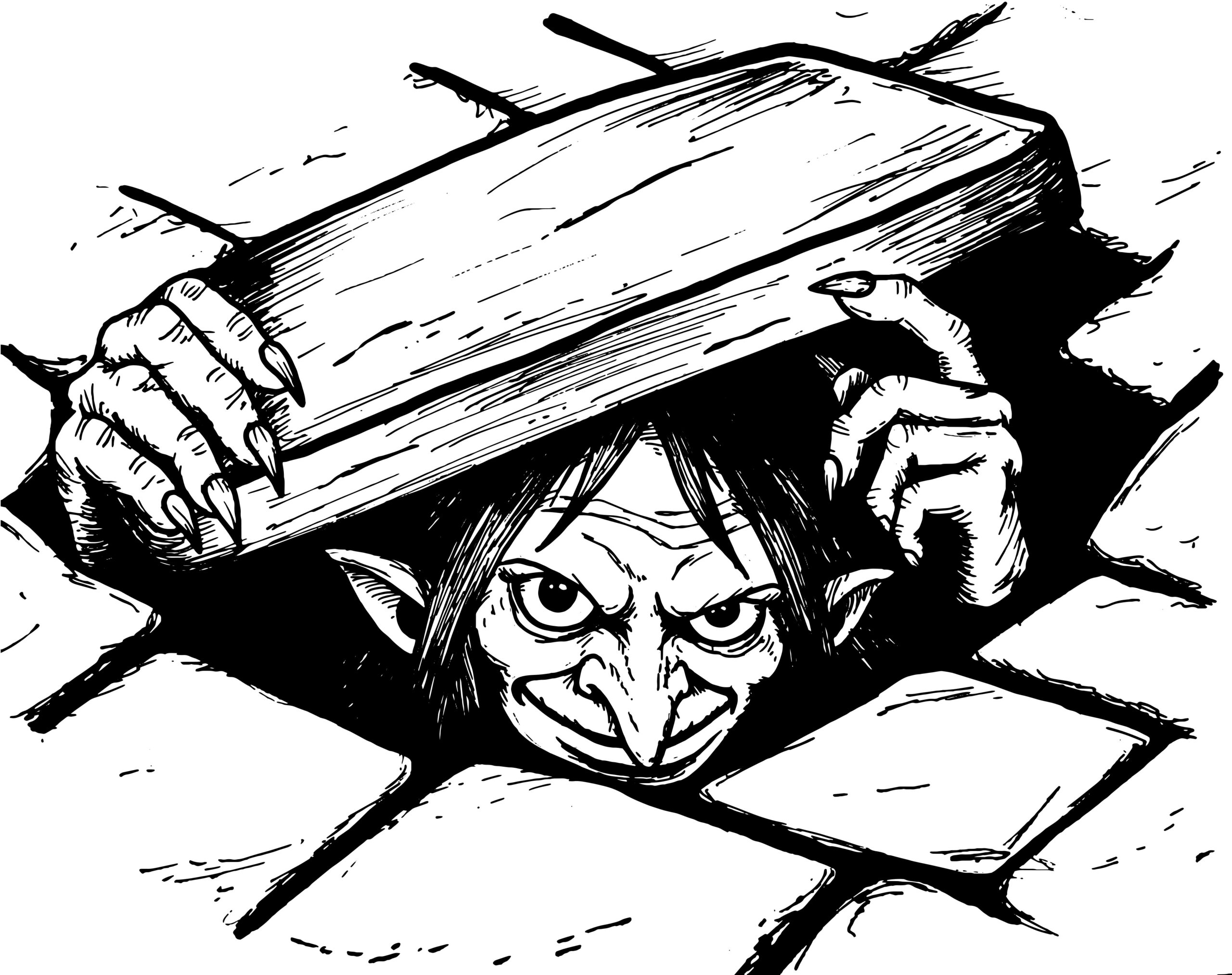
Boggarts are supernatural beings in English folklore, most commonly associated with areas in northern England. The term was used quite broadly, such as to describe a ghost or spirit or to refer to a more specific type of creature similar to a brownie or a goblin. Their temperaments could range from helpful to ambivalent, or from mischievous to outright malevolent, depending on the account.
In different traditions, boggarts were blamed for missing possessions, causing bad luck, making food spoil, or causing accidents. Children were also warned that boggarts would steal them away, especially if they misbehaved or wandered somewhere they shouldn’t be.
The 1852 Boggart of Blackley Haunting
In the village of Blackley, Manchester, a man by the name of William Whitehead reported that a boggart had taken up residence in an old building adjoining the White Lion public house. Whitehead was a clogger who had lived at the property for ten months and had first heard the boggart six weeks before the report appeared, “when it made noises like the cackling of a hen, or the moaning whistle on a railway; and when any of the family stood upon a certain flag in the back room, it screamed like a child.”1
The boggart made noise every night, and even during the day sometimes, and the family reported that at one point, a kettle full of boiling water was moved from the fire to the middle of the floor. Understandably, Whitehead wanted a solution to this haunting.
Having identified the flagstone that appeared to elicit a reaction from the creature, Whitehead removed this stone from the floor and dug several feet down, where he found “a cream-jug, filled with lime and bones”. At a village conference to discuss the strange events, the bones were declared to be those “of a human being, and that, at some period, a person had been murdered, and, of course, buried in a cream jug.”
Some locals declared that the boggart must be the ghost of “Old Shaw’s wife”, a woman who had formerly resided in the Old Hall, which was close to the allegedly haunted building, while others suggested, “its appearance is consequent upon the wickedness of some of the neighbours”.
As the boggart’s antics and noise grew, so too did Whitehead’s desperation to be rid of it, and he spent a whole day digging in search of the spirit, removing all the cellar steps and excavating a large hole nearly sixteen feet long, four feet wide, and more than five feet deep, but it yielded no results. An astrologer from Manchester was called in with “magic books” to try to solve the mystery, too, but seemingly also didn’t succeed.
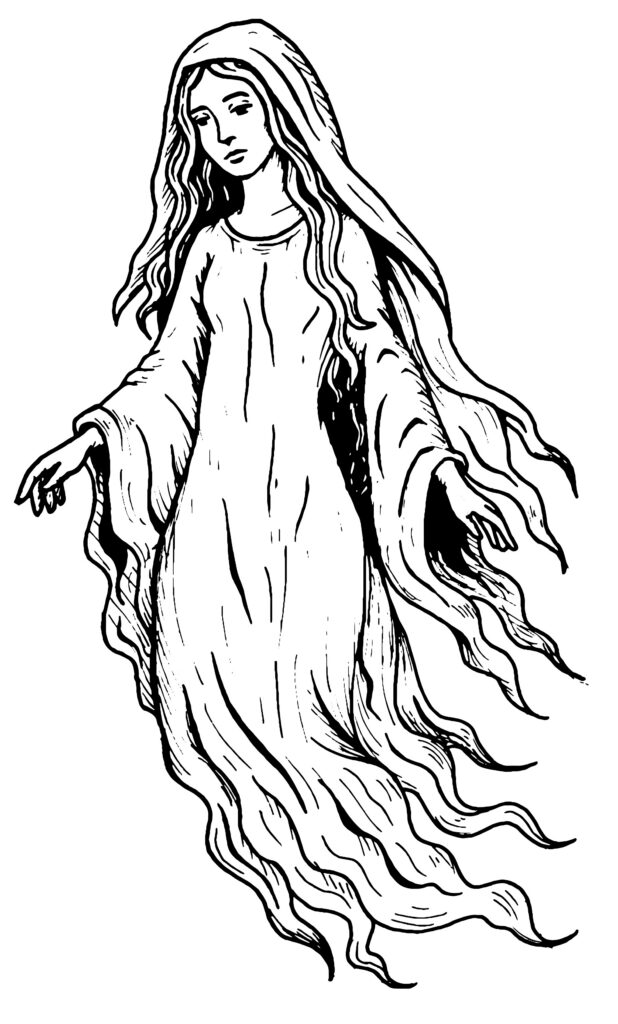
George Horrox, who once resided in the same location, claimed that on two separate occasions he saw “the ghost in the shape of a young woman” and that it “occasionally made noises like the rumbling of stones”. Other locals gave similar accounts, claiming the house had been haunted for 85 years.
Whitehead would not be swayed from his mission in trying to get to the bottom of the mystery, with the article stating, “The man who resides in the building shows no symptoms of fear, on the contrary, he declares he will find out what the annoyance proceeds from before he gives in; but it is in vain to tell many of the old people that it is anything but a boggart or ghost, and many families have left on that account.”
According to the Manchester Courier, and Lancashire General Advertiser, many folks had visited the “haunted dwelling”, so much so that it states “the publicans and beersellers will no doubt reap a rich harvest from the boggart hunters”. A police officer who was sceptical of the supernatural resided only a few yards away from the location, and the newspaper posited that he would likely have “his duties increased by this troublesome spirit”.
Was the Incident Ever Resolved?
Many other newspapers later shared the tale, but it seems that there was no direct follow-up to Whitehead’s dilemma and whether he ever managed to rid his home of the boggart. What I did find was a passing reference to the incident in an article in The Middleton and Rochdale Albion, and General Advertiser published in 1857, five years after the original events. This article appears to doubt the discovery of the bones.
“They invited a professed astrologer from Manchester, who persuaded the old cobbler that the ghost’s appearing was a sign that a murder had been committed, and that the corpse must have been buried in the house. He set to work, and made a hole six feet deep, four feet wide, and nine feet in length. Here he pretended to find some human bones.”2
There is no evidence given for why this reporter felt the discoverer of the bones “pretended” to find them. The later account corroborates several details from the original report, including the local belief that the boggart was Old Shaw’s wife, and adds that she was someone “who it is said was murdered in the late old hall”.
According to the 1857 article, a Mr Nicholson lived in the hall around 1760 and, like many of the other locals, “was superstitious enough to believe in spirits or ghosts, and that the hall was haunted with what were generally called in those days, boggarts. The idea was strongly entertained that some person had been murdered about the place.”
This account also mentions that the boggart took the form of a woman. “The inmates frequently heard, or fancied they heard, the rumbling of something like stones, during the winter nights; the building also rocked and shook, and several did not hesitate to say that they had seen the sperrit, in the shape of a female dressed in white. Occasionally they fancied the boggart was accompanied by a large black dog.
“The most popular notion amongst them was, that the boggart was old Shay’s wife, and I find that even at the present time several old people in the village are believers of the same. The last occasion on which this ancient ghost disturbed the inmates of the hall was in March, 1815.”
Was the Boggart Old Shaw’s Wife?
Blackley Old Hall stood close to the Old White Lion public house. Before the Scholes family occupied the hall, it had been tenanted by a family named Shaw or Shay.
Nearly forty years later, the Middleton newspaper The Guardian published another account, describing Nicholson as the man “who first discovered that the ghost of old Shay’s wife made itself very officious about the old mansion, making unearthly noises in the dead of night, and taking liberties with the crockery ware and doors of the rooms”3. Yet the same article later describes Nicholson as the man who “confirmed the popular rumour that the hall was haunted”, further reinforcing the idea that the haunting pre-existed his arrival.
The article also reports “a mysterious rumour in the village of a murder that had been done in the wasty rooms” and describes the supposed apparition as a “melancholy visitor” and “a figure in white”.
The writer then offered a distinctly Victorian (and overtly misogynistic) joke as supposed evidence for the ghost’s identity: “There are two circumstances which make for the probability of this story. The common people, who are nearly always right, agreed in declaring that the ghost was none other than old Shay’s wife.
“Now, as we all know, such is the vigour of life in womankind, especially in scolds, and worrying and over-anxious women, that in some way or other they survive death, and tease their favourite victim till he joins them in the spirit world. And in the next place the very date when this unhappy spirit last visited Blackley Hall was in the wild month of March, 1815, the very year that Scholes’ lease expired.”
However, the presence remained. Even after the hall was torn down, it is said that the “ghost of old Shay’s wife, or some other evil spirit, had cursed the place, for nothing appeared to prosper on the spot” and the article states that “nobody yet has ventured to dispute the identity of Blackley Hall ghost with old Shay’s wife”.
One belief was that the ghost of Shay’s wife, accompanied by her black dog, visited the hall at the end of every twenty-one years, dating probably from the time of her death.
I have found no contemporary record identifying Old Shaw’s wife by her first name or substantiating the claim that she was murdered at Blackley Hall.
Blackley’s Other Boggarts: Boggart Hole Clough
This wasn’t the only Blackley boggart. The area is also home to Boggart Hole Clough, which, as its name suggests, has long been associated with tales of a boggart.
John Roby vividly described the famous Boggart Hole Clough in his Traditions of Lancashire:
“You descend, clinging to the trees, and scrambling as best you may,—and now you stand on haunted ground! Tread softly, for this is the Boggart’s clough; and see in yonder dark corner, and beneath the projecting mossy stone, where that dusky sullen cave yawns before us, like a bit of Salvator’s best, there lurks the strange elf, the sly and mischievous Boggart.”4
A local writer later questioned whether Roby’s tale preserved a genuine Blackley tradition. In 1892, the Manchester Times claimed that Thomas Crofton Croker had supplied Roby with a story borrowed from an earlier publication, concerning a farmer named George Cheetham “of whom nobody in Blackley or Moston heard”. This raises the possibility that the tale was later attached to Boggart Hole Clough rather than collected from local oral tradition.5
Several modern websites claim that numerous children disappeared in Boggart Hole Clough from the eighteenth century onwards, with their disappearances supposedly attributed to the boggart. I haven’t been able to find any historical newspaper reports or local histories backing up this claim. What is documented is the oral tradition of children being warned that boggarts would carry them away if they misbehaved, wandered too far, or remained in the Clough after dark.
Simon Young’s The Boggart Sourcebook: Texts and Memories for the Study of the British Supernatural collects accounts from various people. One respondent raised in Collyhurst during the 1950s recalls, “When we were naughty, we were always told that we’d be taken by the Boggarts”. 6 Another, who grew up in nearby Crumpsall, remembered his mother warning him about boggarts, “My mum used to always say behave or the Boggarts will come for you as we were leaving to go to the fair without her. It kept us on our toes.”7
Another respondent remembered a local belief that a boggart could turn milk sour: “I grew up in Blackley Manchester near a park called “Boggart Hole Clough”. According to local legend, there was a farm in the valley and a spirit lived there. When he was annoyed he would turn the milk sour and do other objectionable things. I made sure I never went down into the valley where there was a cafe unless my dad was there.”8
Boggarts were apparently considered so common throughout the area that in Lancashire Folk-Lore: Illustrative of the Superstitious Beliefs and Practices, Local Customs and Usages of the People of the County Palatine, it states “they are too numerous for us to attempt a full enumeration” after listing “There are the boggart of Clegg Hall, near Rochdale; the Clayton Hall Boggart, Droylsden; the Clock House Boggart, in the same neighbourhood; the Thackergate Boggart, near Alderdale, and many others”.9
Tales of boggarts continue to be passed down from generation to generation, especially for those who live within a stone’s throw of Boggart Hole Clough. You certainly wouldn’t find me traipsing around that area alone on a dark night.
William Whitehead appears to have never found the answer he was looking for beneath the floor of his home. The noises were never conclusively explained, the bones never formally identified, and there seems to be no evidence that proves a woman named Shaw was murdered at Blackley Hall. What we do know is how readily one strange disturbance became absorbed into a much older local tradition, joining a history of unexplained Blackley incidents with its various hauntings, boggarts, and bumps in the night.
The Original 1852 Article
EXTRAORDINARY SUPERSTITION AT BLACKLEY
The peaceable and well-disposed inhabitants of the pleasant village of Blackley have been thrown into a state of considerable excitement by the alleged re-appearance of a ghost, or boggart. The house where this unearthly visitor has chosen to take up its winter’s residence is a very old building, adjoining the White Lion public house, occupied by a person named William Whitehead, a clogger, who has resided there for the last ten months.
He states that he first heard the “boggart” about six weeks ago, when it made noises like the cackling of a hen, or the moaning whistle on a railway; and when any of the family stood upon a certain flag in the back room, it screamed like a child. Whitehead removed the flag, and, after digging a hole several feet deep, found a cream-jug, filled with lime and bones.
A village conference was assembled, and several declared that the bones were those of a human being, and that, at some period, a person had been murdered, and, of course, buried in a cream-jug. The “boggart” is heard every night in the week, and occasionally during the day. The ancients of the place declare it is “Old Shaw’s wife,” a woman formerly resident in the Old Hall, which stood near to the haunted building; others say its appearance is consequent upon the wickedness of some of the neighbours.
On Saturday evening it made greater noise than usual, and on Sunday Whitehead was digging nearly all day in search of the supposed spirit; the cellar steps were removed, and a very large hole nearly sixteen feet long, four feet wide, and above five feet deep, was excavated, of course without success. We advise him next to set a trap; he may catch something.
The family state that a few days ago the kettle (full of boiling water) was removed from the fire to the middle of the house floor. An astrologer, from Manchester, with his magic books and glasses has visited the house, and parties looked through the latter to see if they could learn from whence came the spirit.
An old man named George Horrox, who once resided in the dwelling, declares that on two occasions he saw the ghost in the shape of a young woman, and it occasionally made noises like the rumbling of stones. Several others give similar accounts, and they do not hesitate to say the house has been haunted for the last 85 years.
The man who resides in the building shows no symptoms of fear, on the contrary, he declares he will find out what the annoyance proceeds from before he gives in; but it is in vain to tell many of the old people that it is anything but a boggart or ghost, and many families have left on that account.—It is rather astonishing to see so many people in the nineteenth century running to visit a haunted dwelling, but numbers are attracted to the place, and the publicans and beersellers will no doubt reap a rich harvest from the boggart hunters.—The police officer, who resides only a few yards distant and is professionally a sceptic in all matters relating to supernatural appearances, seems likely to have his duties increased by this troublesome spirit.10
Archive Sources
- “Extraordinary Superstition at Blackley”, Manchester Courier, and Lancashire General Advertiser, 06 November 1852, p.7. ↩︎
- “Blackley. A Singular Character”, The Middleton and Rochdale Albion, and General Advertiser, 28 November 1857, p. 1. ↩︎
- “The History and Annals of Old Blackley and Neighbourhood”, The Guardian (Middleton), 31 January 1891, p. 6. ↩︎
- John Roby, Traditions of Lancashire, 4th ed., 2 vols. (London: George Routledge and Sons, 1867), chap. 19, “The Bar-Gaist,” Global Grey Ebooks, accessed 12 July 2026. ↩︎
- “Notes and Queries: Blackley,” Manchester Times, 1 July 1892, p.5. ↩︎
- Simon Young, comp. and ed., The Boggart Sourcebook: Texts and Memories for the Study of the British Supernatural (Exeter: University of Exeter Press, 2022), p. 158, OAPEN Library, accessed 12 July 2026, doi:10.47788/QXUA4856. ↩︎
- Young, The Boggart Sourcebook, p. 162. ↩︎
- Young, The Boggart Sourcebook, p. 140. ↩︎
- John Harland and T. T. Wilkinson, Lancashire Folk-Lore: Illustrative of the Superstitious Beliefs and Practices, Local Customs and Usages of the People of the County Palatine (London: Frederick Warne; New York: Scribner, 1867), p. 52, Internet Archive, accessed 12 July 2026. ↩︎
- “Extraordinary Superstition at Blackley”, Manchester Courier, and Lancashire General Advertiser, 06 November 1852, p.7. ↩︎
Subscribe to The Folklore Archive!
Each fortnight for The Folklore Archive, I’ll uncover lost stories, superstitions, and traditions that have faded from memory by digging into old historical newspapers and folklore collections.
From mischievous pixies to curious folk remedies, if you want to read about the weird and wonderful history of British folklore, I’ll deliver it straight to your inbox.
I’ll also be sharing my original pen-and-ink illustrations and updates on my writing projects, particularly for my book on Devon Folklore.
I’d love to have you along for the journey, so please subscribe below!
Occasionally, the first edition wanders into the junk folder. Newsletters are sent from author@megpelliccio.co.uk, so please add the address to your contacts and check your junk folder when the next issue arrives.